How can you tell whether your CRM is truly delivering the results your business expects? What exactly should you analyze: sales, team productivity, automation, or customer retention? And most importantly, how do you calculate the effectiveness of the system in a way that provides a realistic picture rather than just a favorable percentage in a report?
To answer these questions, companies analyze CRM ROI (Return on Investment).
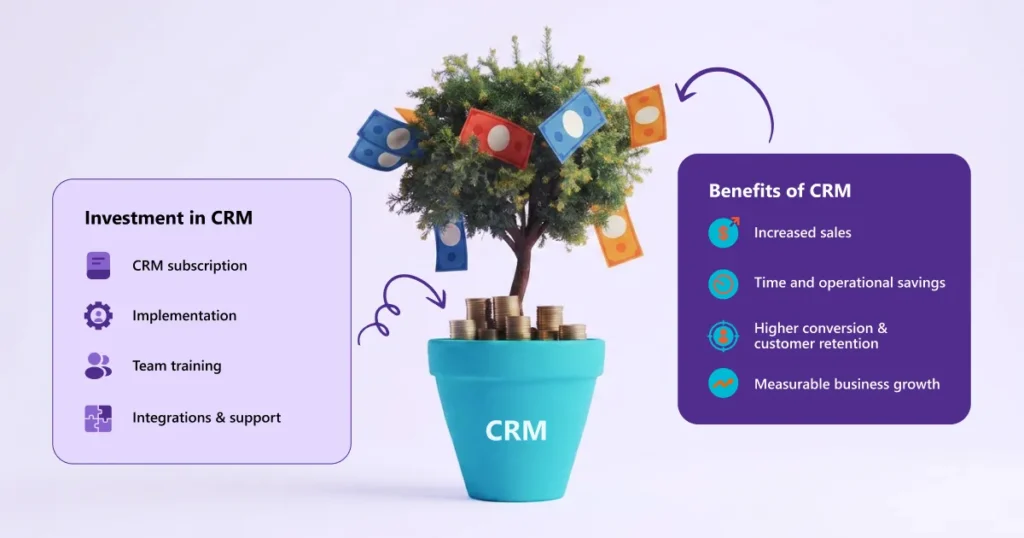
CRM ROI is a metric that measures the relationship between the business value generated by a CRM system and the total corporate costs associated with it. While additional revenue is the primary consideration, a meaningful CRM ROI calculation should also take a number of contextual factors into account.
CRM ROI is not determined solely by how actively the system is used. What matters is its effectiveness: reducing operating costs, increasing team productivity, accelerating lead processing, improving customer service, and successfully retaining customers. According to industry statistics, companies generate an average of $8.71 for every $1 invested in CRM.
In many companies, CRM ROI is used as a key indicator for evaluating implementation effectiveness, justifying budgets, and making decisions about further investment in the system.
Regular analysis of CRM ROI enables businesses to:
ROI is most commonly calculated using the following formula: ROI = (Benefits − Costs) / Costs × 100%
Where:
However, it is important to remember that the formula itself is only the framework of a broader analysis. To accurately assess CRM ROI, it is essential to correctly identify both benefits and costs.
A CRM system directly impacts sales, but that is not its only function. It also helps automate processes, save employees’ time, and improve customer interactions. Therefore, when calculating CRM ROI, businesses should consider not only the revenue generated, but also the resources saved, such as:
One of the most common mistakes when calculating CRM ROI is considering only the cost of the system subscription. In reality, CRM costs are much broader and should include:
Once a business has identified its benefits and costs, it can move on to calculating CRM ROI. However, to get a relevant result, it is not enough to simply put numbers into the formula. It is necessary to go through all stages of the analysis step by step: define goals, collect baseline data, evaluate results, and correctly interpret the final metric. How exactly can this be done?
First, it is necessary to determine what exactly the business wants to evaluate. A CRM system can affect different processes, so without a clear goal, the analysis can quickly turn into a set of unrelated metrics.
For example, a company can analyze:
Before calculating CRM ROI, a business needs a starting point. Otherwise, it will be difficult to understand whether the CRM system has actually made a difference.
For this purpose, companies usually record baseline metrics before implementing the system or launching new CRM processes. These may include:
At the same time, it is important to collect all cost-related data: subscription fees, integrations, training, configuration, system support, and the team’s working time. This stage creates the foundation for further CRM ROI analysis.
Once the business has baseline data, it can proceed with calculating the return on investment. This is where theory turns into practice: the business begins to understand which processes have the greatest impact on CRM ROI and where the system delivers the most value.
The formula can be used with the total value of benefits or with individual sources of results, for example:
The final ROI percentage alone does not provide a complete picture. In addition to the figure itself, it is important to understand how quickly the CRM system paid off and how exactly the business achieved the desired results.
For example:
Revenue growth is one of the first metrics businesses should look at after implementing a CRM system. However, revenue alone does not always show the actual impact of the system.
For example, sales may increase due to seasonality, a marketing campaign, or team expansion. Therefore, for a more objective CRM ROI assessment, companies often additionally analyze:
A CRM system affects the entire sales process. That is why, when evaluating ROI, it is important to analyze intermediate metrics that show team effectiveness at different stages of the sales funnel.
Companies most often focus on:
For many companies, the main value of a CRM solution lies in long-term customer relationships.
A CRM system helps businesses better track interaction history, personalize communication, and respond faster to customer needs. As a result, businesses can:
One of the most practical benefits of CRM is time savings for teams. This impact is often underestimated when calculating ROI, even though saving just a few hours per week for each manager can eventually translate into real financial value.
Automation of routine processes allows managers to spend less time on administrative tasks and more time working with customers and generating sales. In this context, a CRM system can automate:
Practice is the best teacher. Let’s imagine a company with a sales team of 10 managers that implemented a CRM system to automate sales and lead management. During the first year, the business achieved the following results:
CRM costs:
Total costs: 227,000 UAH
Results after CRM implementation:
Total CRM benefits: 540,000 UAH
In this case, ROI is calculated as:
ROI = ((540 000 — 227 000) / 227 000) × 100 ≈ 138%
This means that the CRM system not only paid back the implementation costs but also generated additional business value for the company.
Of course, in real business environments, CRM ROI calculation is often more complex: companies may analyze the impact of CRM separately on sales, customer retention, team productivity, or operational costs.
CRM ROI calculation may seem relatively simple, but in practice companies can easily obtain inaccurate results due to the following mistakes:
CRM ROI is a useful metric for evaluating system effectiveness, but it does not always provide a complete picture — especially when business results are assessed only through short-term financial outcomes.
Part of CRM’s impact does not appear immediately. Teams need time to adapt to new processes, automation gradually changes daily workflows, and improvements in customer experience are often visible only in the long term.
Moreover, not all CRM benefits can be easily translated into numbers. A system can improve:
These improvements do not always have an immediate impact on revenue, but they create a foundation for sustainable business scaling.
It is also important to note: a high ROI does not necessarily mean that the CRM system is being used to its full potential. Conversely, some companies may show moderate ROI at the start, while still significantly improving processes and building long-term growth potential.
To unlock the full potential of a CRM system and maximize its business value, it must be implemented correctly, integrated into daily team workflows, and used as a tool for process development. Only then does it become a source of long-term business value.
If you want to choose a CRM system tailored to your business needs and configure it in a way that consistently delivers strong ROI, request a consultation — the SMART business experts will help you select and customize the right solution.