
Customer feedback management is today one of the key factors shaping the quality of the customer experience, loyalty, and business growth. At the same time, simply collecting customer feedback is not enough for many companies. It is far more important to understand what problems the feedback points to, set priorities, implement the necessary changes, and tell customers about the results.
That is why a modern approach to working with customer feedback combines two interrelated concepts. Voice of the Customer (VoC) helps a company systematically understand customers’ needs, expectations, and experiences, while Closed-Loop Feedback ensures a complete cycle for every significant piece of feedback, from receiving it to implementing changes and communicating back to the customer.
A CRM system plays a key role in this process, bringing customer feedback together with sales data, interaction history, support requests, and other customer information. As a result, the company works not with isolated comments but with a full picture of its relationship with each customer.
In this article, we will look at what customer feedback management is, how a CRM helps automate feedback handling, what Voice of the Customer and Closed-Loop Feedback are, and how to build a process that turns customer feedback into real business improvements.
Customer Feedback Management is a structured process of collecting, centralizing, analyzing, and using customer feedback to improve products, service, business processes, and customer interactions. Unlike simply gathering comments or ratings, Customer Feedback Management assumes that every important signal must be analyzed, assigned an owner, and, when necessary, turned into specific actions.
Customer feedback can come from dozens of different sources: surveys, support requests, email, social media, online chats, conversations with sales managers, marketplace reviews, or even users’ behavioral data in digital services. If these signals remain scattered, the company sees only isolated problems. But when all the data is centralized in a CRM, the business gets a complete picture of each customer’s experience and can identify recurring patterns.
It is also important to distinguish between an individual review and a systemic problem. A single negative comment may point to an isolated situation. By contrast, dozens of similar requests from different channels often signal shortcomings in the product, the service process, or internal business processes. That is why Customer Feedback Management covers not only work with individual customers but also the analysis of trends that affect the company’s development.
In other words, collecting feedback is only the first stage. Managing customer feedback begins when the company turns the information it has received into concrete decisions, monitors their implementation, and measures the result.
Some people equate customer feedback management with running customer satisfaction surveys. In fact, a survey is just one way of collecting customer feedback.
Surveys, such as CSAT (Customer Satisfaction Score), NPS (Net Promoter Score), or CES (Customer Effort Score), help measure customer satisfaction or loyalty. However, they reflect only part of the customer experience.
A full-fledged system for managing customer feedback also takes into account:
It is the combination of different sources that makes it possible to form an objective picture of customer needs. If a company analyzes only survey results, it risks missing problems that customers do not report directly but that show up in their behavior or repeated requests.
However, combining different sources is not enough either. A company needs not just to accumulate individual signals but to understand what they mean for the customer and the business, find recurring patterns, and use the resulting insights to make decisions. This is where the company moves from separate feedback collection tools to a systematic Voice of the Customer approach.
Voice of the Customer (VoC) is a strategic approach that helps a company systematically collect, analyze, and use information about customers’ needs, expectations, and experiences to make business decisions. Unlike standalone surveys or feedback collection, Voice of the Customer covers the entire process, from receiving customer signals to implementing changes and evaluating how effective they are.
The core idea of VoC is that the customer’s opinion should influence not only the work of the support team but also product development, marketing campaigns, the sales process, after-sales service, and other areas of the company’s activity. This makes it possible to base decisions not on assumptions but on customers’ real experience.
A voice of customer feedback program usually consists of several interrelated stages:
It is this continuous model that helps a company not only respond to individual requests but also constantly improve the customer experience.
For example, if a company regularly receives feedback about a complicated checkout process, Voice of the Customer helps it see that these are not isolated cases but a systemic problem. In that case, the task is not only to respond to specific customers but also to review the entire checkout process, test a new flow, and assess whether the changes have really improved the customer experience.
Voice of the Customer and Customer Feedback Management are closely linked. While Customer Feedback Management describes the process of working with customer feedback, Voice of the Customer defines the strategic approach that helps turn the feedback received into long-term improvements to the product, the service, and customer interactions.
A CRM system helps a company connect customer feedback with the context of their interactions with the business and turn the information received into specific actions. Instead of isolated ratings, comments, or complaints, the company gets a complete picture of the customer’s experience and can identify problems, priorities, and opportunities for improvement faster.
When feedback arrives through different channels, it often remains scattered without a centralized environment. For example, a post-contact rating may be stored in the support system, a customer’s comment in email, and information about their dissatisfaction in a sales manager’s notes. In such a situation, it is harder for the company to see the full picture and understand how an individual signal relates to the overall relationship with the customer.
A CRM brings this data together and links it to a specific customer. A manager can access purchase history, previous requests, communications, open deals, survey results, and other data without switching between several systems. This makes it possible to assess feedback not in isolation but in the context of the customer’s entire journey.
For example, a customer contacts support because their order was delivered late for the second time in a row. In the CRM, this feedback is attached to the customer’s record, where the manager immediately sees the history of previous requests, purchases, active deals, and other interaction data. If the system shows that the customer has already reported a similar problem, makes regular purchases, and has an active deal, the request can be automatically flagged as a priority and passed to the responsible manager.
Next, the CRM makes it possible to quickly create a task to handle the complaint, set a response deadline, and record the outcome of the communication.
A CRM also makes it possible to move from working with individual pieces of feedback to analyzing recurring problems. If a company regularly receives similar comments from different customers, the system helps group these signals by topic, segment, product, or stage of interaction. This makes it possible to identify a problem that is not always visible when analyzing individual requests.
For example, if customers consistently point to the complexity of a particular stage of the checkout process, a CRM system can help reveal this pattern. Feedback can be categorized automatically or manually by topic, tagged, and linked to a specific product, customer journey stage, or type of request. With filters, reports, and dashboards, the company can see how often a given problem occurs, which customer segments encounter it, and whether the number of such requests is growing.
Managing customer feedback with a CRM helps companies:
The effectiveness of working with feedback largely depends on how well the company has built this process in the CRM. It is important to define which signals the company collects, where they come from, how to categorize them, who is responsible for handling them, and how to monitor the result. That is why the next step is to build a complete picture of the sources and types of customer feedback that should be taken into account in the CRM.
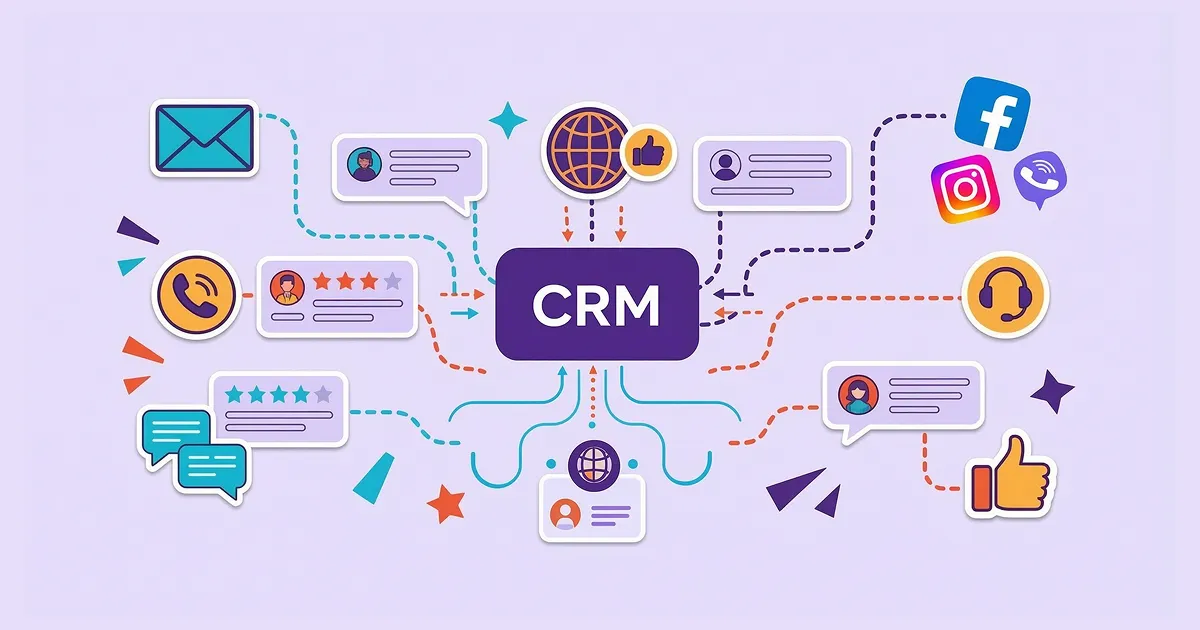
A CRM system can combine direct, indirect, and behavioral signals from customers so that the company gets a fuller picture of their experience. One channel is usually not enough for this: a customer may rate the service in a survey, complain to a manager, leave a comment on social media, or not write about the problem at all but show their dissatisfaction through their behavior.
That is why, when building a Customer Feedback Management process, it is important to take into account not only what customers say directly but also the signals that can be obtained from other interaction channels.
Direct feedback is information that a customer provides to the company on their own, expressing an assessment, opinion, wish, or complaint. This is the most obvious type of customer feedback.
Such sources include:
In a CRM, this data can be linked to a specific customer, deal, product, or request. For example, a low rating after service can automatically create a task for the responsible manager to follow up with the customer.
Not every customer leaves formal feedback or fills out a survey. At the same time, ordinary communication with the company can produce signals that help you understand the customer’s experience, difficulties, or expectations. That is why it makes sense to use a CRM not only for storing ratings and complaints but also for recording the context of interactions.
To get a fuller picture of the customer experience, a CRM system can centralize information from different customer interaction channels. This means you are not limited to formal ratings or surveys but can also take into account the context of communication, customer requests, their comments, and other signals that may indicate needs or problems.
The main channels and sources that can be integrated with a CRM or recorded directly in the system include:
For example, a customer may not fill out a survey after a purchase but contact support several times with a question about the same functionality. If these requests are stored in the CRM and share a common category or tag, the company can see a recurring signal even without formal negative feedback.
This is why a CRM helps you not to lose the customer signals that arise in ordinary communication and to link them with other data about the customer.
Customer behavior data forms a separate category. It is not feedback in the direct sense, but it can signal satisfaction, difficulties, or changing needs.
For example, a company can take into account:
Such signals are especially valuable in combination with direct feedback. For example, if a customer gave the service a low rating and then stopped using the product, a CRM can help link these events and draw the manager’s attention in time to a potential churn risk.
A single piece of feedback provides only part of the information, while combining different sources makes it possible to see the full context of the interaction with the customer. That is why it makes sense to analyze data on ratings, requests, communications, purchases, and customer behavior together.
For example, a CSAT of 3/5 on its own only shows that the customer is not fully satisfied. But if the CRM also shows three support requests over the past month, an open deal, and a drop in purchase volume, the company gets a much more important signal. It may point not just to dissatisfaction with a specific interaction but to a risk of losing the customer.
This kind of centralization makes it possible to move from simply collecting customer feedback to analyzing it systematically. The next stage is to determine how to process, categorize, prioritize, and turn these signals into specific actions.
The customer feedback management process in a CRM is not a one-time collection of ratings but a repeating cycle in which every significant signal goes through several consecutive stages: from collection and centralization to analysis, assigning an owner, taking action, and verifying the result.
For this to work systematically, the CRM must have defined rules for handling feedback: what data is collected, how it is classified, who is responsible for handling it, how quickly the company needs to respond, and when a request can be considered closed.
In simplified form, the process looks like this:
Collection → Centralization → Analysis → Prioritization → Action → Response to the customer → Evaluation of the result
This approach makes it possible not to lose important signals and to monitor not only the fact that feedback was received but also what the company did afterward.
The first stage is to ensure that feedback from different channels flows into a single environment. A CRM can receive data from surveys, the support team, email, online chats, social media, and other systems through integrations, or record information that employees enter during interactions with the customer.
It is important that each signal is linked to a specific customer, product, service, deal, or stage of the customer journey. Then the manager sees not just an isolated comment but its context.
To organize feedback in a CRM, you can use categories, tags, request types, and other attributes. For example, a message can be labeled “delivery problem,” “service quality,” “new feature request,” or “service complaint.” This simplifies later searching and analysis of recurring signals.
Once centralized, feedback needs to be turned into structured information. A CRM can help group it by topic, product, customer segment, sentiment, urgency, or other parameters.
For example, ten negative reviews about the same stage of the checkout process can be combined into one category. This makes it possible to see the problem not as ten separate requests but as a recurring signal.
To analyze large volumes of text feedback, a company can also use AI tools: automatic classification, sentiment analysis, identification of key topics, and detection of recurring patterns. At the same time, automated analysis should not completely replace a human, especially in complex or potentially conflict-prone situations.
Prioritization also matters. The number of reviews does not always determine how important a problem is. A single negative signal from a strategic customer with a large open deal may require a faster response than dozens of less critical comments.
That is why a CRM can take into account not only the topic and rating of the feedback but also the customer segment, the potential value of the relationship, churn risk, open deals, and other business metrics.
After a priority is set, you need to work out who exactly should respond to the feedback and what needs to be done.
In a CRM, you can create a task for this, assign a responsible employee, set a deadline, and, if necessary, configure automatic escalation. For example, a complaint about service quality can go to the head of the support team, a request for a new feature to the product team, and a risk of losing a major customer directly to the responsible manager.
It is also important to separate individual responses from systemic changes. Some problems can be resolved directly with the customer, while a recurring signal may require a change to the product, a business process, the terms of service, or internal company policy.
That is why working with feedback often requires cooperation among several teams: sales, support, marketing, product, and operations. A CRM helps record the owner, the task status, and the result, so that information does not remain only in personal correspondence or an individual employee’s notes.
Completing an internal task does not mean the work on the feedback is finished. The customer should receive a response and, where appropriate, learn what changes or actions were taken.
For example, if a customer reported a problem with a particular feature, it is not enough simply to pass the information to the product team. Once the issue is resolved, the responsible manager should tell the customer about the outcome, explain the changes made, or offer an alternative solution.
In the CRM, this result should be recorded along with the feedback status, the date of the response, and the actions taken. This makes it possible to track how long it takes to handle signals, which problems remain open, and how effectively the company responds to feedback.
After that, the cycle does not necessarily end for good. New feedback makes it possible to check whether the changes really solved the problem. It is this repeating process (receive the signal → understand it → act → inform the customer → verify the result) that turns Customer Feedback Management from simple feedback collection into a permanent mechanism for improving the customer experience.
Closed-loop feedback is a model in which a customer’s feedback goes through a full cycle: the company receives the signal, analyzes it, determines the necessary actions, resolves the problem, tells the customer about the result, and uses the information gained to keep improving its work.
In other words, closing the feedback loop does not mean simply ticking a “done” box in the CRM. If a customer complained about a problem and an employee passed the information to the responsible department, the internal work is not necessarily finished. It is important to understand whether the problem was resolved, whether the customer needs to be told about it, and whether the same situation is recurring in other cases.
For example, a customer reports that a complicated checkout process kept them from completing a purchase. In the CRM, you can record this feedback, link it to the specific order, and pass the task to the responsible manager. If the company simplifies the checkout process, the customer can be told about the changes and invited to try again. Later, the CRM can help track whether the number of similar requests has dropped and whether the customer experience has changed.
At the same time, a closed loop can work at different levels. In some cases, the company needs to quickly resolve the problem of a specific customer. In others, it needs to use recurring feedback to find the systemic cause and change the process itself. The concepts of Inner Loop and Outer Loop Feedback are used to describe these two levels.
The Inner Loop is work with a specific customer and their situation. The main goal is to respond to the feedback quickly, resolve the problem, and restore normal interaction with the customer.
For example, a customer received an order late and left negative feedback. In the CRM, you can link this feedback to the specific order and the history of previous requests, assign a responsible manager, and create a task to handle the situation. The manager finds out the reason for the delay, offers the customer a solution, and records the result in the CRM.
The Outer Loop approach works more broadly. Its task is to identify recurring problems and understand what the company can change so that similar situations occur less often.
If the CRM shows that over several months different customers regularly complain about delivery delays, the company can already treat this not as a series of separate cases but as a systemic signal. Data analysis might reveal, for example, problems with inventory planning, logistics, or coordination between departments. The outcome of the work is then not only a response to individual customers but a change to the relevant business process.
The difference can be put simply:
Customer feedback has value not in itself but when a company uses it to make decisions and improve how it interacts with customers. Collecting ratings, comments, and requests only lays the foundation for further work. For the data to deliver results, it needs to be centralized, analyzed, linked to the context of the customer interaction, and turned into specific actions.
A CRM system helps build such a process in a single environment: combine feedback from different channels, link it to customer data, automate task assignment and monitoring of their completion, and analyze recurring signals. This makes it possible not only to respond to individual problems faster but also to identify patterns that may affect the quality of the product, the service, and business processes.
It is the combination of Customer Feedback Management, Voice of the Customer, and Closed-Loop Feedback that makes it possible to move from passively collecting customers’ opinions to working with them systematically. The company understands what exactly needs to change, who should do it, and how to evaluate the result.
So if a company faces scattered feedback across different channels, loss of information between departments, the lack of a single process for handling requests, or cannot tell which customer problems need attention first, a CRM can become the foundation for building such a process.
SMART business helps companies implement and develop CRM solutions tailored to the specifics of their business processes: from centralizing customer data and automating work with feedback to integrating the CRM with other corporate systems and using modern AI capabilities.
If you want to systematize your work with customer feedback, improve service quality, respond to problems faster, and turn customer signals into a basis for business decisions, request a consultation, and SMART business experts will help you determine how to organize Customer Feedback Management in your CRM and which tools best fit your processes.