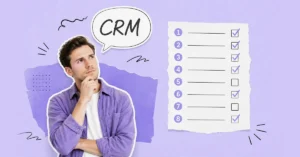

A scalable sales process is a repeatable, measurable system for managing customer relationships from the first contact to closing a deal. It can be replicated across teams of any size without compromising quality or results.
According to McKinsey, high-growth companies invest in building sales operating infrastructure 1.4 times more often than low-growth companies. This infrastructure provides the foundation for turning chaotic sales activities into a predictable system. In other words, it is a structured sales process and operational support for the sales team — not simply having people with targets — that determines whether the team’s efforts translate into stable, predictable results.
If, at some point in your business growth, you realize that your sales team is performing and targets are being met, but everything depends on a few key people — and removing them would cause the system to start falling apart — that is not scalability. It is dependency. This is where the line lies between sales that depend on individual people and sales built around a process. In this article, we’ll explore how to build a sales process that can be replicated across any team — from laying the foundation and defining the key sales stages to implementing standards, measuring performance, and addressing common scalable sales process blockers.
Sales scaling is often mistakenly associated with hiring new sales reps or investing in new tools. But without the right foundation — processes, standards, and high-quality data — expanding the team and introducing automation will only accelerate the chaos rather than improve results. Before scaling your sales team, it is worth addressing a few basic issues.
ICP is not an abstract portrait of a “good customer.” It is a specific description of the companies and contacts with whom you close deals fastest, most easily, and at the highest average deal value. Industry, business size, decision-maker role, typical business challenge addressed by your product — all of this should be documented in the system rather than kept in the heads of two experienced sales reps.
Without a clear ICP, lead qualification becomes a lottery: each sales rep evaluates a prospect through their own lens of experience and intuition. One may spend weeks pursuing a company that is fundamentally not a fit for the product. Another may turn away a promising prospect on the first call because they “don’t look like our typical customers.” Neither is making a deliberate mistake — they simply lack a shared point of reference. Once the ICP and qualification criteria are documented in the system and clearly understood by the entire team, the decision about whether to continue working with a lead no longer depends on an individual sales rep — it becomes part of the sales process.
Practical step: Build a sample of deals with different outcomes and customers with different levels of profitability and retention. This will help you identify common characteristics that correlate with long-term partnerships.
When every sales rep works differently — qualifying leads differently, moving customers through the sales funnel, and handing deals over to the next stage in different ways — scaling is impossible. In such an environment, a new sales rep has no choice but to follow what they see around them: they pick up other people’s habits and adapt to informal rules that no one has consciously defined. Over time, they reproduce the same inconsistency that the company hoped to eliminate by hiring another person.
Work standards are not bureaucracy. They answer simple questions: What qualifies as a qualified lead? What steps should a sales rep take at each stage of a deal? When and how should a handoff between teams take place — for example, from marketing to sales or from sales to customer service? Without clearly defined handoff points, leads are lost precisely at the interfaces between teams—and no one considers it their responsibility.
Practical step: For each stage of the sales funnel, document three things: what the sales rep needs to do, what they need to obtain from the customer, and what they need to pass on to the next person or team. If this description is clear enough for someone who has just joined the company, the standard works.
A CRM without high-quality data is an expensive notebook. If fields are only partially completed, deals sit without a status, and sales reps manage their actual work in a notebook or in their heads, no amount of automation or AI will help. It will simply automate the mess.
Basic data quality means that every deal has its key fields completed, a defined next step, and an accurate status in the sales funnel. Lead source, customer type, reason for losing a deal — all of these are data points that are essential for analyzing results and making informed decisions about the sales process.
Practical step: Define the minimum set of mandatory fields for each stage of the sales funnel and make completing them a prerequisite for moving a deal to the next stage. Filling in these fields should not be perceived as a formal requirement or punishment, but as a necessary part of the process.
It is also beneficial when a CRM allows a company to quickly and independently customize its functionality: add new fields, change process logic, and adapt to new business needs. This is especially important when scaling, as the system needs to flexibly adapt to new teams, customer segments, or additional sales stages.
One such solution is the SMART CRM platform from SMART business. It combines rapid customization capabilities with the flexibility businesses need to scale their processes without compromising data quality.
A repeatable sales process does not come from an online template or by copying a competitor. It is built from the inside out — from understanding how the best deals are actually closed in a particular company, which customers they involve, and which steps lead to success.
Analyze a representative sample of won, lost, and stalled deals, as well as customers with different levels of profitability, retention, and satisfaction. Compare which characteristics and scenarios are most often associated with successful, long-term relationships. For an initial analysis, you might start with 15–20 deals, provided this sample is sufficient for your sales volume. Break down each deal: Where did the customer come from? Who was the decision-maker? What steps did the sales rep take? Where did the customer hesitate, and what convinced them? How long did each stage take? The patterns you identify in these deals will become the foundation of your repeatable sales process — not a hypothetical one, but one that actually works for your business.
Tip: Analyze won deals together with the sales reps who closed them. Record common characteristics in a simple table: lead source, contact role, key objection, what convinced the customer, and the number of touchpoints before closing. Three or four such analyses can provide more insight into the actual sales process than any external framework.
The role of CRM: Once you have this understanding, you can scale the process in your CRM. Instead of relying on manual spreadsheets and reviews, CRM analytics tools can automatically track lead sources, contact roles, key objections, and the number of touchpoints before closing. This makes it possible to identify patterns in real time, quickly adjust the process, and implement standards across the team. In this way, a CRM becomes a system for scaling your best sales practices — from analyzing won deals to establishing repeatable sales process standards.
This step follows logically from analyzing your deals: your best customers will always share certain characteristics that are different from those of customers whose deals were delayed or lost. Turn these characteristics into qualification criteria, and sales reps will spend less time on customers who are fundamentally not a fit and more time on prospects with the highest likelihood of closing.
Tip: Create two lists—a “yes” list and a “no” list. The first should describe the characteristics of customers with whom deals close quickly and at a high deal value. The second should describe characteristics that have historically led to lengthy negotiations, discounts, or lost deals. Both lists should be specific—not “large businesses,” but “a company with 50+ employees in industry X and a sales team of more than 10 people.”
The role of CRM: A CRM allows you to make these criteria part of the system. Instead of keeping “yes/no” lists in internal documents, you can configure qualification fields in the CRM: lead source, company size, contact role, industry, key objections, and more. This makes it possible to automatically track whether a customer matches your profile, quickly filter out unqualified leads, and focus the team on prospects with the highest likelihood of success.
SMART CRM from SMART business allows companies to customize qualification criteria independently and adapt them to different customer segments. This makes the scaling process transparent and manageable: sales reps work according to common standards, while managers have access to high-quality, real-time analytics.
Each sales stage should answer a specific question: What has happened with the customer for the deal to reach this stage? For example, moving a deal to the “proposal sent” stage should mean more than simply sending an email. It should mean that the sales rep has established the budget, identified the decision-maker, and received confirmation that the business need is still relevant. Without such criteria, the sales funnel reflects sales rep activity rather than the actual state of deals, making any forecasts based on it unreliable.
Tip: For each stage of the sales funnel, write one sentence in the format: “A deal moves to this stage when…” and another: “A deal cannot move forward if…” This will immediately reveal where the criteria are vague and where sales reps do not actually know what needs to happen for a deal to progress.
The role of CRM: Modern CRMs allow you to configure conditions for moving between stages. For example, a deal cannot move forward until key fields are completed or the next step has been recorded. This keeps the team disciplined and makes the sales funnel an accurate reflection of the actual state of sales, rather than simply of sales rep activity.
Each transition point in the sales process should be clearly defined: who hands the deal over, to whom, what exactly is handed over, and when. The biggest number of leads are lost not within individual stages, but at the interfaces between teams: marketing hands a lead over and sales fails to follow up; sales closes a deal and customer service does not receive the necessary context. This is not a question of trust between departments — it is a question of whether there is a clear agreement on how the handoff should happen.
Tip: Identify all handoff points in your sales process and define three things for each one: the trigger (what initiates the handoff), the content (what exactly is transferred and in what format), and the owner (who confirms that the handoff has taken place). If any of these three elements is not documented, the handoff point is a risk area.
The role of CRM: A CRM helps make these handoffs manageable and trackable. You can configure automated triggers in the system: when a lead moves from marketing to sales, a task is created for the responsible sales rep; when a deal is closed, the service team receives the full context from the relevant CRM fields. This reduces the risk of information getting lost and makes handoffs transparent for everyone involved in the process.
Call scripts, email templates, qualification criteria, common objections, and ways to address them should all be part of the standard.
Tip: Ask one of your strongest sales reps to document what they do at each stage of a deal — not what they are supposed to do, but what they actually do. This document will serve as a draft for your standard. Then compare it with what other sales reps do. The gaps between them are precisely where the process needs the most standardization.
The role of CRM: A CRM system can store and update call scripts, email templates, qualification checklists, and standard responses to objections. A new sales rep can access them directly in the interface instead of searching through files or asking colleagues. This reduces the risk of each new hire “inventing their own approach” and ensures consistent quality across the team.
SMART CRM from SMART business allows companies to quickly customize these standards to their processes: add new templates, update qualification criteria, and integrate training materials. As a result, even new hires can start working according to the same rules from day one, while managers can see whether those standards are being followed in real deals.
Sales process automation and AI in sales are areas where companies often make the same mistake: they implement tools before establishing the process itself. The result is predictable — automation accelerates chaos rather than eliminating it. AI generates more activity but does not improve its quality. The investment is made, but the expected impact never materializes.
The rule here is simple: automate only what already works and what is clearly understood. If sales reps do not know when and how to follow up manually, automated reminders alone will not fully solve the problem. If qualification criteria have not been documented, AI lead scoring will reproduce the same mistakes — just faster.
When the foundation is in place, sales process automation and AI can genuinely strengthen the sales team in several ways:
Automatic activity logging, trigger-based follow-up reminders, and email templates personalized using CRM data allow sales reps to spend less time on administrative tasks and more time on actual customer interactions. This is one of the most straightforward ways to automate the sales process.
SMART CRM from SMART business integrates these AI tools without complex configuration. Companies can define their own routing rules, while the system can adapt as the business scales to accommodate new products, customer segments, or regions.
Any of the CRM solutions implemented by SMART business can be enhanced with AI. Deal-closing predictions, personalized offers, automated responses, and lead scoring are already available as part of solutions that integrate with existing sales team processes rather than requiring them to be rebuilt from scratch. Take a short survey to find out which CRM solution is right for your business:
Scaling is easy to confuse with growth. More sales reps, more leads, and a bigger target do not necessarily mean you are scaling. There is one real test: can results be reproduced independently of specific individuals, and do they become more predictable as the team grows? These are the sales process metrics that can answer that question.
The first sign that a process is scaling is that results stop being the “phenomenon of one sales rep.” If one person in the sales team closes 70% of all deals while the rest of the team falls significantly behind, you do not have a scalable process. You have individual performance.
Look at the gap between sales reps: what is the difference in conversion between your top performer and the average? If the difference is more than 2–3 times, the problem is with the standards, not the people. The goal of scaling is to narrow this gap by raising the average performance to the level currently achieved only by your top performers.
In practice: if your best sales rep closes 40% of deals from qualified leads while the average rep closes 18%, the question is not how to hire another “star salesperson.” The question is what exactly the top performer is doing — and how to standardize it across the team.
Overall lead-to-deal conversion is a useful number, but it does not show where you are losing the most customers. For scaling, it is important to track conversion at each stage separately.
For example, 60% of leads move from the initial call to a demo — is that good or bad? It depends on your ICP and product. But if only 15% of leads convert at the demo stage instead of the expected 40%, that is a clear signal: either your qualification is too loose and unqualified prospects are making it to demos, or the initial call is not addressing objections effectively enough before the next step.
Track conversion between stages by sales rep, lead source, and customer segment. This gives you a precise view of where there is a systemic problem in the sales process, rather than simply showing that “sales are down.”
The deal cycle is one of the clearest indicators of how manageable your sales process is. If it varies significantly between sales reps or customer segments, the process has not yet been standardized.
Track not only the average cycle length but also where deals spend the most time. If most deals get “stuck” between the proposal stage and the final decision, this is a signal that either the proposal does not address the customer’s actual needs or the sales rep is not actively guiding the customer through the decision-making process and is simply waiting for a response.
Practical benchmark: if a deal remains at one stage for more than twice the average time spent at that stage, it is not simply delayed. It is a deal that requires active intervention or should be removed from the funnel.
Time to the first deal for a new sales rep is perhaps the most honest indicator of how well-documented and repeatable your sales process really is. If a new sales rep reaches stable performance within 6–8 weeks, you have a process. If it takes 5–6 months and constant support from colleagues, the standards exist only in the heads of experienced team members.
Track three metrics separately: time to the first call, time to the first qualified lead, and time to the first closed deal. If any of these metrics varies significantly from one sales rep to another, look for the cause in the onboarding process rather than in the individuals.
A scalable sales process is measured not only by results but also by how consistently the team follows the process itself. If 30% of deals in the funnel have no recorded next step, half of lost deals have no documented reason for the loss, or the lead source is unknown, analytics based on this data will provide little value.
Introduce a simple data quality audit every two weeks: what percentage of deals at each stage have all mandatory fields completed? What percentage of lost deals have a documented reason? These numbers show not only the quality of your data but also how consistently sales reps actually follow the standards — as opposed to simply agreeing to them in theory.
If actual sales regularly differ from forecasts by more than 20–25%, the cause may be more than market changes. It may also point to the quality of your sales funnel and the criteria used to evaluate deals.
Track forecast accuracy monthly and by sales rep. If one sales rep consistently makes accurate forecasts while another constantly overestimates or underestimates results, compare how they evaluate deals at each stage. In many cases, the problem is not the market but the fact that deals are moved between funnel stages based not on actual criteria, but on the optimism or caution of a particular person.
The goal is not perfect accuracy but predictability within a 10–15% variance. This level of predictability allows a business to plan resources, budgets, and hiring based on a realistic picture of sales rather than intuition.
A CRM does not replace the sales process — it becomes the environment in which the process lives and is replicated. Sales funnel stages, transition criteria, work standards, handoff points between teams, and deal analytics only deliver value when they are documented not just in files but in the system the team works with every day.
A scalable sales team is not the result of a single decision. It is the outcome of consistent work: from defining the ICP and qualification standards to implementing the process in a CRM and regularly measuring results. This is where an experienced technology partner plays a key role in configuring the system and helping build a process that works within it.
Want to build a sales team whose results do not depend on two key sales reps and can be predicted a quarter in advance? The SMART business team can help you build a sales process and choose a CRM solution tailored to your business’s scale and needs. Request a consultation and take the first step toward predictable sales.