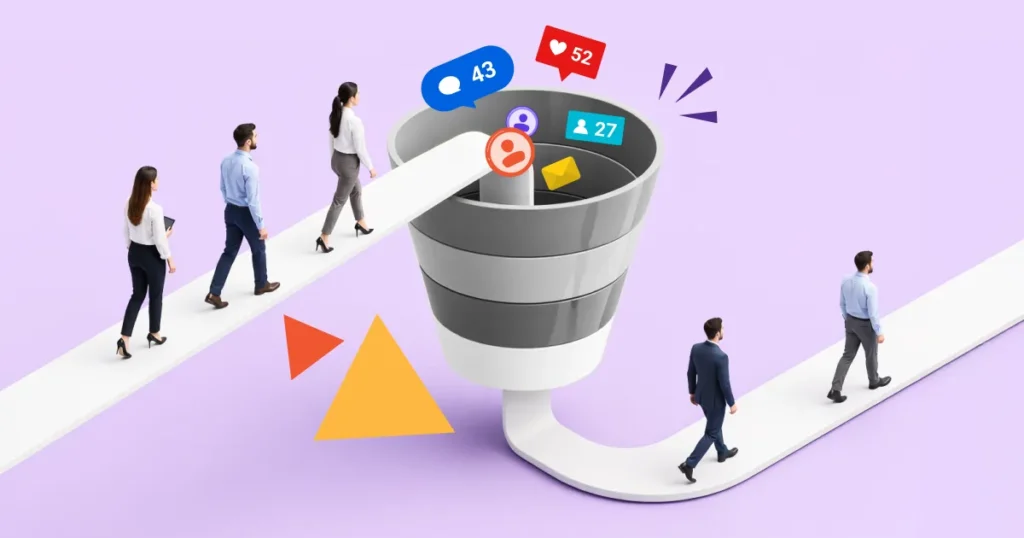
According to the 6sense Buyer Experience Report, nearly 80% of all B2B deals are won by companies that buyers have already chosen before their first direct interaction with the sales team. Prospects often create their shortlist and make their final decision while independently exploring content, customer success stories, reviews, and other resources that a brand makes publicly available. 1
This means that by the time a prospect speaks with a sales representative, they already have a certain level of trust in the company, clear expectations about the product, and a shortlist of vendors they’re willing to consider. That’s why it’s no longer enough to simply drive traffic, generate leads, or guide prospects through the Top of the Funnel (ToFu) and Middle of the Funnel (MoFu) stages. The most critical moment comes at the bottom of the funnel (BoFu) — when a prospect is almost ready to make a purchase but is still weighing risks, comparing alternatives, or looking for the final confirmation that they’re making the right choice.
BoFu (Bottom of the Funnel) is the final stage of the sales funnel, where a prospective customer moves from evaluating options to making a purchase decision. At this stage, the goal of marketing and sales is no longer to capture attention — it’s to give prospects the confidence to say “yes.”
While the Top of the Funnel (ToFu) is focused on building awareness and the Middle of the Funnel (MoFu) helps prospects evaluate available solutions, the Bottom of the Funnel (BoFu) is where they make their final decision regarding a supplier, product or service.
This is why the bottom of the sales funnel serves a different purpose than the earlier stages. Instead of attracting attention or generating traffic, its primary objective is to help qualified prospects make a confident buying decision. By this point, they already understand their problem, know the available solutions, and have narrowed their list of potential vendors.
At this stage, buyers are typically asking questions such as:
That’s why effective BoFu content is built around proof, trust, and specific evidence. Customer success stories, product demos, testimonials, comparison pages, and transparent pricing often outperform another general educational article or promotional banner.
For businesses, BoFu is one of the most critical stages of the marketing funnel because it’s where leads become customers. Even if a company successfully attracts traffic through SEO, paid advertising, webinars, or content marketing, a weak bottom of the funnel can result in a significant number of lost opportunities.
Conversely, a well-designed Bottom of the Funnel (BoFu) strategy can shorten the sales cycle, improve conversion rates, and generate more customers without increasing spending on traffic acquisition.
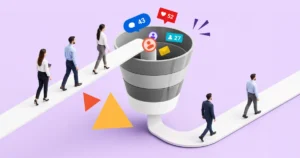
To understand how a sales funnel works, it’s helpful to break it down into three distinct stages: ToFu, MoFu, and BoFu. These aren’t just marketing buzzwords — they represent different levels of buyer readiness, where everything changes, from user behavior to the type of content that influences purchasing decisions.
In the classic sales funnel model, each stage plays a specific role in moving leads toward a final purchase. Simply put, it’s the journey from “I just realized I have a problem” to “I’m ready to buy.”
At the Top of the Funnel (ToFu), prospects are just beginning to recognize a problem or need. They’re not looking for a specific product yet, and they’re certainly not ready to make a purchase.
The primary goal at this stage is to attract traffic and establish the first connection with your brand.
Typical search queries include:
The most effective content at this stage includes:
The purpose of ToFu isn’t to sell — it’s to generate interest and guide prospects further down the funnel.
In the Middle of the Funnel (MoFu), prospects clearly understand their challenge and begin exploring possible solutions. Interest in a product is growing, but they haven’t made a final decision yet.
This is where buyers actively compare vendors, products, and approaches available in the market to determine which solution best fits their needs.
Common search queries include:
Typical MoFu content includes:
At this stage, the priority is building trust and demonstrating expertise. Prospects aren’t ready to buy yet, but they are deciding which companies are credible enough to consider.
BoFu (Bottom of the Funnel) is the final stage, where prospects are almost ready to purchase and are choosing between one and three specific options.
At this point, general educational content is no longer enough. Buyers are looking for answers to highly specific questions, such as:
Typical BoFu content includes:
This is where leads convert into customers. Ultimately, BoFu determines whether all the effort invested in ToFu and MoFu translates into actual revenue.
When comparing ToFu, MoFu, and BoFu, the biggest difference isn’t just the content — it’s the buyer’s intent.
As prospects move through the funnel, their choices become increasingly focused — from exploring a broad topic to selecting a specific solution and vendor.
This is why understanding top of the funnel vs bottom of the funnel is so important. Present BoFu content too early, and prospects won’t be ready. Keep them at the ToFu stage for too long, and they’ll likely choose a competitor before reaching a buying decision.
An effective marketing funnel connects all three stages into one seamless journey, where each step prepares prospects for the next and ultimately guides them toward becoming customers.
Developing an effective BoFu content strategy isn’t about creating just another set of pages on your website. It’s about systematically addressing the needs of prospects who are already close to making a purchase but still need the final reassurance to move forward.
At this stage of the sales funnel, marketing shifts from nurturing awareness to removing the last barriers to conversion. This is often where the decision is made — and where a lead either becomes a customer or walks away.
The first step in building an effective BoFu strategy isn’t content or advertising — it’s data.
The most valuable source of insights for the bottom of the funnel comes from real customer interactions:
These conversations reveal the real objections that prevent prospects from making a buying decision.
Common questions include:
It’s important not only to collect these questions but also to group them by theme. Together, they create a map of your prospects’ concerns at the bottom of the funnel.
That map can then be transformed directly into BoFu assets such as comparison pages, FAQs, customer success stories, and product demos.
The second step is matching content precisely to buyer intent.
At the BoFu stage, prospects are no longer interested in general educational articles. They are looking for information that helps them make a confident purchase decision.
Each piece of content should answer a specific question:
This creates a guided path to purchase, where each step naturally leads to the next. The fewer unnecessary steps between interest and action, the higher your conversion rate.
The final step is connecting all customer-facing channels into one cohesive system.
BoFu doesn’t exist independently of marketing and sales. On the contrary, it’s where these two functions overlap the most.
Three key tactics make this possible:
1. Remarketing
When someone has already visited your website, viewed a case study, or watched a product demo, remarketing can present:
2. Email marketing
At the BoFu stage, email becomes a personalization tool by delivering:
3. CRM and Sales integration
At this stage, it’s essential for marketing and sales to operate as a single system. That’s why many organizations implement CRM solutions that enable them to:
In this context, SMART business helps organizations connect marketing and sales through CRM solutions, including SMART CRM and products built on Microsoft Dynamics 365. This creates a structured process that guides prospects through the bottom of the sales funnel and toward a purchase.
As a result, BoFu stops being simply the last stage of the funnel and becomes the point where leads turn into customers — and where all the work invested in ToFu and MoFu delivers measurable business results.
Evaluating BoFu performance isn’t about website traffic or page views. At this stage of the sales funnel, the key question is different: how consistently and efficiently prospects become paying customers.
This is where the focus shifts from generating interest to measuring actions that directly impact conversions and revenue. Understanding how to evaluate bottom of the funnel optimization requires tracking specific metrics.
This is the most fundamental of all bottom of the funnel metrics. It shows what percentage of qualified leads ultimately become customers.
The formula is simple:
(Number of customers / Number of leads) × 100%
However, this metric reflects much more than a percentage. It is influenced by:
While some drop-off is expected during the ToFu and MoFu stages, losses at the BoFu stage have a direct impact on revenue. Even a small decline in conversion can significantly affect business performance.
At this stage, it’s important to identify exactly where prospects abandon the buying process.
Three critical conversion points should be analyzed:
These metrics reveal how effectively marketing and sales work together. If there is a disconnect between the two teams, the BoFu stage is often where conversion losses become visible.
Time is another critical performance indicator. At the BoFu stage, success depends not only on whether prospects buy, but also on how quickly they reach a decision.
The sales cycle shows:
When the BoFu process is optimized:
As a result, buyers make decisions faster, reducing unnecessary delays and repeated follow-ups. This contributes directly to bottom of the funnel growth by increasing sales velocity and improving revenue predictability.
The final area to measure is the economics of BoFu.
Here, companies evaluate not only the number of conversions but also their cost.
However, at the BoFu stage, lead quality is often even more important than acquisition cost. Not every lead is equally ready to buy. Organizations should analyze:
These insights are typically gathered using various bottom of the funnel analytics platforms that demonstrate how effective the complete marketing funnel is.
Ultimately, BoFu performance isn’t measured by isolated numbers. It is evaluated as a connected sequence:
Leads → Engagement → Decision → Purchase → Customer Acquisition Cost
The more closely these elements are aligned, the more predictable revenue becomes and the stronger the bottom of the sales funnel performs.
Many prospects are lost at the very last stage of the sales funnel — when they are just one step away from making a purchase decision. In most cases, the reason is a poorly designed BoFu strategy.
One of the most common challenges in bottom of the funnel lead nurturing is continuing to educate prospects when they are already ready to buy.
At the top of the sales funnel, educational content such as blog posts, guides, webinars, and research reports is highly effective at attracting prospects and building trust. At the bottom of the funnel, however, people are no longer looking for general information about their problem — they want to understand which solution to choose and why they should choose yours.
The result: prospects fail to find answers to their final questions and move on to a competitor.
How to fix it: instead of publishing another educational article, offer customer success stories, solution comparison pages, product demos, pricing calculators, FAQs, or a consultation with an expert. These assets directly support purchase decisions and help optimize the bottom of the funnel customer experience.
Another of the most common bottom of the funnel lead nurturing challenges is failing to provide enough evidence that the solution actually delivers results. If a company talks only about its own strengths without demonstrating real results, the level of trust drops significantly.
At the decision stage, buyers are looking for proof — not promises. They want to know what outcomes other companies have achieved, what implementation looked like, which business challenges were solved, and how long it took to see results.
The result: leads remain stuck comparing alternatives or postpone their purchase indefinitely.
How to fix it: use customer case studies, testimonials, product demo videos, implementation stories, and measurable business outcomes. Pay special attention to addressing the most common objections related to pricing, implementation risks, deployment timelines, and post-purchase support.
Sometimes companies create high-quality BoFu content but overlook the most important part — showing users what to do next.
For example, after reading a case study or viewing a product page, a potential customer may not see a clear call to action, may be unable to request a demo quickly, or may be forced to fill out a lengthy form with dozens of fields.
The result: some potential buyers simply postpone reaching out or leave the website altogether.
How to fix it: every BoFu asset should guide users toward one specific action. That action might be requesting a product demo, booking a consultation, asking for a commercial proposal, or starting a product trial. The simpler the path to making contact, the higher the conversion rate.
Another common problem arises when marketing and sales operate independently of one another. The marketing team creates content based on its own assumptions, while sales managers hear customers’ real objections and questions every day.
As a result, BoFu content fails to address the issues that actually influence purchasing decisions.
The result: marketing continues generating leads, but the conversion rate from leads to closed deals remains low.
How to fix it: regularly collect feedback from both the sales team and customer support. These teams know better than anyone which factors prevent customers from buying, which questions come up most often, and which arguments are most effective in closing deals. The most effective BoFu is almost always created at the intersection of marketing, sales, and customer success.
A successful BoFu is a system that helps potential customers overcome doubts, get answers to their most important questions, and confidently move forward with a purchase.
BoFu may look like a collection of content, landing pages, and well-crafted CTAs on paper. In reality, however, it is about something much more important: how quickly a company can recognize a customer’s buying intent and respond appropriately. Without a CRM system, analytics, and close alignment between marketing and sales, the bottom of the funnel simply cannot scale.
At the decision-making stage, every user action matters: viewing a case study, opening a sales proposal, or returning to a product page. If these signals are not brought together into a single picture, BoFu becomes nothing more than a series of disconnected touchpoints instead of a manageable sales process.
Within BoFu, the CRM system is where the entire customer journey toward a purchase is recorded — from the very first interaction to the final buying decision.
This is where sales automation becomes essential. The system not only stores customer data but also helps sales representatives identify which prospects are “hot,” who is reviewing a proposal, and who has stalled because of unresolved concerns.
SMART business implements Microsoft-based CRM solutions that connect marketing, sales, and customer service into a single, streamlined customer engagement process.
One of SMART business’s approaches is the implementation of SMART CRM, its proprietary platform built on Microsoft technologies. The solution supports the entire customer lifecycle — from the initial inquiry to repeat sales.
Within this ecosystem, businesses can leverage solutions such as:
The Microsoft Dynamics 365 ecosystem can also be implemented, including:
For companies with highly specialized or non-standard business processes, SMART business takes a different approach. Instead of forcing unique workflows into an off-the-shelf solution, the team develops custom solutions that address specific CRM requirements and fit seamlessly into the company’s internal business processes.
Together, these approaches — from ready-to-use platforms to fully customized solutions — provide a solid foundation that transforms BoFu from “the last few pages of a website” into a fully managed part of the business process.
BoFu analytics answers a simple question: why does a customer buy — or decide not to? At this stage, it is not enough to measure conversions alone. Companies also need to understand behavioral patterns, such as:
Once these insights are available, marketing stops relying on intuition and becomes a structured system for influencing customer decisions.
One of the biggest advantages of a well-designed BoFu is speed. As soon as a lead shows signs of being ready to buy, the system should:
This is what automated lead nurturing looks like in practice: prospects no longer get lost between marketing and sales but move through a clearly defined path toward closing the deal.
In many cases, the biggest BoFu problem is not the content itself but the fact that different tools operate independently. Marketing works in one system, CRM in another, and analytics somewhere else entirely.
Modern businesses therefore focus on integration, bringing together data from advertising platforms, websites, CRM systems, and customer service into a single environment.
At SMART business, this is achieved through end-to-end process implementation and SMART Connectors that integrate multiple systems into one unified data ecosystem. This provides complete visibility into the customer journey without gaps between channels.
Another important layer is the use of AI within CRM systems. Today, AI-powered solutions can:
As a result, BoFu is steadily evolving from a manually managed process into one supported by intelligent automation.
Ultimately, CRM and analytics provide the foundation that allows BoFu to function as a true system rather than a collection of isolated activities. Together, they create a unified mechanism in which every lead follows a defined path and every interaction moves that lead closer to a purchase.
Therefore, if you notice that potential customers are getting stuck at the final stage of the funnel, failing to convert into buyers, or if you simply cannot determine where your leads are being lost, it is a clear sign that your BoFu strategy needs to be rethought. The same applies when marketing and sales operate separately, leaving the customer journey fragmented and difficult to manage.
SMART business helps organizations build a complete sales funnel management system — from CRM and analytics to process automation and a transparent customer journey. If you’d like to understand where your leads are dropping off, improve your BoFu conversion rates, or build a more manageable sales process, request a consultation. The SMART business team will analyze your funnel, identify growth opportunities, and strengthen your sales processes with modern technology solutions.