In the world
of digital business, terms like sales funnel and marketing funnel are often
used interchangeably. This is a common mistake that reduces effectiveness,
leading to inefficient budget allocation and team frustration.
Although
these two systems are inseparably linked and together form the complete
customer journey, they serve entirely different purposes. What is a funnel as a
cohesive whole? It is the foundation of modern conversion architecture.
Understanding the differences between them, and how to integrate them, is
crucial for the sustainable scalability of any business.
To fully
understand the customer acquisition process, we first need to answer the
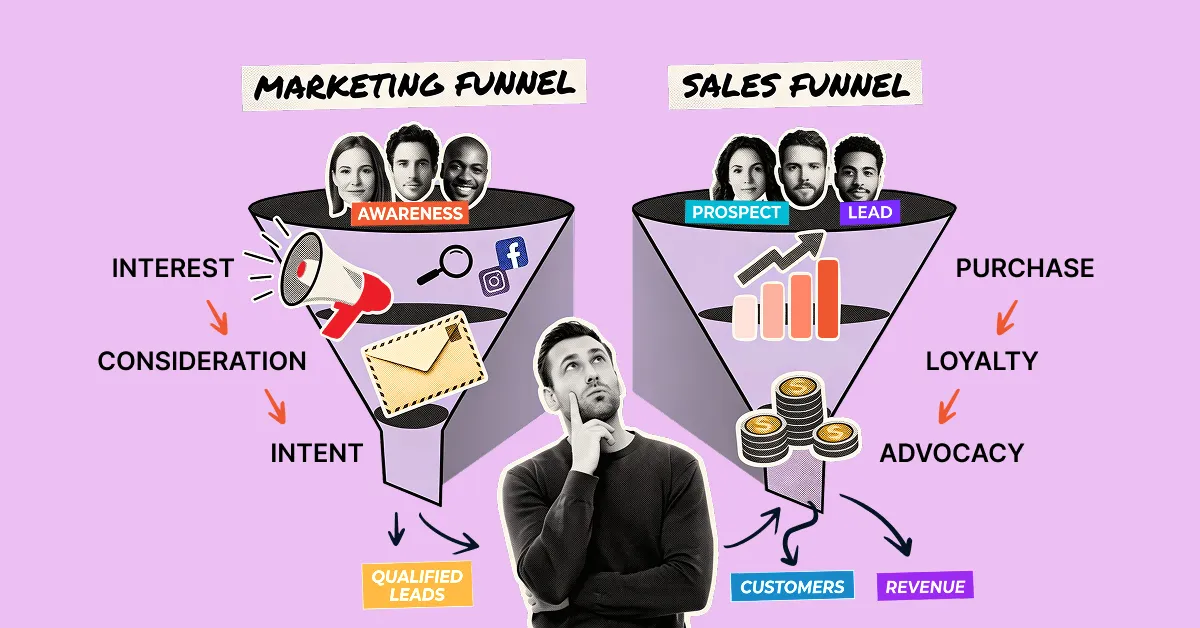
question: what is a marketing funnel? By definition, it is a structure that
covers the top (Top of the Funnel — ToFu) and middle (Middle of the Funnel —
MoFu) stages of the buyer’s journey. This is where a potential customer first
comes into contact with your company.
In the past,
activities at these stages were often viewed purely as brand-building efforts.
Today, this approach has changed dramatically. A report by McKinsey
& Company clearly shows that a
well-designed full funnel is the primary growth engine for an organization.
Marketing is no longer seen as a pure expense — it has become a strategic
partner to sales, directly driving financial results by delivering valuable
sales opportunities.
However,
before this strategic impact translates into measurable revenue, the marketing
funnel must fulfill its fundamental purpose: it must capture attention and
convert an anonymous audience into potential customers who show initial
interest in your brand. In practice, each stage of the marketing funnel
includes:
·
Building awareness: Using digital marketing channels (SEO, content marketing, social
media) to reach a broad audience.
·
Generating interest: Encouraging users to engage more deeply with the brand, for example by
downloading an e-book or registering for a webinar.
·
Nurturing: Providing valuable content that builds trust and addresses the
challenges of potential customers.
This process
continues until the prospect is qualified as an MQL (Marketing Qualified Lead)
— a contact ready to be handed over to the sales team, but not yet for a direct
sales conversation. Before an MQL becomes a fully qualified SQL (Sales
Qualified Lead), it requires further nurturing — and the quality of this stage
determines the effectiveness of the entire funnel.
Once
marketing has done its job, the sales team steps in. To understand the sales
funnel, we need to look at the very bottom of the buyer’s journey — the Bottom
of the Funnel (BoFu). An effective sales funnel begins exactly where marketing
activities end: when a generated lead (MQL) is handed over.
At this
stage, the direct work of the sales team is crucial. Their task is to turn the
acquired contact into an active customer. Key activities at this stage include:
· Qualification: Verifying whether
the MQL actually has a budget, a need, decision-making authority, and a defined
purchase timeframe — the four criteria of the standard BANT framework — thus
converting it into an SQL (Sales Qualified Lead).
· Offer: Preparing a
tailored solution and presenting the added value of specific services or
products.
· Negotiation: Addressing
objections, adjusting terms, and building a business relationship.
· Closing: Signing the
contract and finalizing the transaction.
Detailed
guidance on how to properly structure and optimize this stage of customer
acquisition is available in our dedicated guide: A Seamless Sales Funnel: How CRM Keeps
Every Lead in Focus.
Imagine a
company that manufactures industrial machines.
Understanding the difference
between the marketing and sales funnels requires looking at the key operational
pillars of each department. While they together form an integrated conversion
funnel, their priorities are distinct. The table below clearly shows how the
two funnels differ:
| Marketing Funnel(ToFu & MoFu) | Sales Funnel (BoFu) | |
| Responsibility | Marketing team | Sales team |
| Main Goal | Build reach, generate leads (MQLs), and nurture them |
Lead qualification (SQL), deal closing, and revenue generation |
| Customer Relationship | “One-to-many” model (mass/segmented communication) |
“One-to-one” model (direct, personalized interaction) |
| Key Metric | Cost per Lead (CPL), website traffic, engagement metrics |
Win rate, average deal value, sales cycle length |
| Cost per Lead (CPL), website traffic, engagement metrics |
Achieving
full synergy between marketing and sales (so-called smarketing) is often
limited by technological and organizational constraints. Even carefully planned
processes lose efficiency when key customer data is scattered across
independent systems and spreadsheets. These information silos can cause
marketing-generated leads to lose value or become outdated by the time they
reach sales.
Breaking down
silos is fundamental. Equally important is establishing an internal SLA
(Service Level Agreement) between marketing and sales. This is a clear, two-way
agreement: marketing commits to delivering a specific quantity and quality of
MQLs, while sales commits to contacting each lead within the agreed timeframe.
To prevent
budget leakage and enforce SLAs effectively, modern organizations centralize
their operations on advanced CRM platforms (e.g., Microsoft Dynamics 365).
These platforms act as a digital backbone, connecting the top of the funnel
with hard sales data in real time. Technology is meant to save salespeople time
and free them from repetitive tasks, not replace human interaction. Automating
administrative processes simply creates the essential space for people to focus
on high-value activities.
If you want
to learn more about how such solutions are architected from the ground up,
check out our article: The Microsoft Dynamics CRM Ecosystem: What
It Includes and How It Works.
Seamlessly
connecting marketing and sales activities is the key to building a profitable
organization. Understanding where marketing ends and sales begins allows you to
guide potential customers more effectively through the entire buying journey.
To fully
optimize this shared funnel and truly increase sales, you need to centralize
your data. However, simply purchasing a license for advanced software will not
solve operational challenges. The system must be precisely mapped to your
company’s unique processes.
This is
exactly where SMART business experts come in. As an official Microsoft
technology partner, the team designs data flow architecture so that the system
becomes an invisible assistant.
If you want
to see how professional CRM implementation by SMART business experts can
accelerate your sales team’s work and help them close more deals — request a
consultation. We’ll show you how to perfectly align tools with your sales
funnel, so the system takes over administrative routine while your team gains
time for what matters most: building customer relationships and generating
measurable revenue.
The main
difference lies in the goal and the stage of the customer journey. The
marketing funnel focuses on building awareness and generating leads (MQLs),
while the sales funnel is responsible for direct negotiations and converting
those leads into revenue.
The
transition point between the two funnels is when a qualified lead (MQL) is
handed over from marketing to sales. Sales representatives then verify the
contact, and if it meets the business criteria, convert it into an SQL (Sales
Qualified Lead).
One of the
most commonly used models is AIDA, which divides the journey into: Attention,
Interest, Desire, and Action. This model covers both marketing stages
(ToFu/MoFu) and the sales stage (BoFu).
Neither is
more important — they are interdependent. In B2B, the decision-making process
is long, so without a strong marketing funnel, sales would have no leads to
engage with. At the same time, without an effective sales funnel,
marketing-generated interest would not translate into revenue.
Key metrics
include Cost per Lead (CPL), website conversion rate, Cost per Click (CPC), and
the total number of MQLs generated within a given period.
An MQL
(Marketing Qualified Lead) is a contact who has shown interest in marketing
content and fits the ideal customer profile. An SQL (Sales Qualified Lead) is
an MQL that has been further verified by a sales representative in terms of
actual need, budget, and readiness to buy.
The most
common tools include Marketing Automation systems (for managing campaigns and
lead nurturing) and advanced CRM systems (e.g., Microsoft Dynamics 365), which
unify data and automate information flow between departments.