
How do you understand what a potential customer wants? How do you avoid offering a technical guide to someone who hasn’t yet recognized their need, and at the same time not lose someone who is already waiting for a concrete offer or demo? And most importantly — how do you build communication that is relevant, timely, and truly useful?
In modern marketing, understanding context is essential: what exactly the user is searching for, what level of awareness they have, and how close they are to making a decision. This is exactly what the TOFU, MOFU, BOFU model is designed for — an approach that helps align marketing activities with the customer’s journey toward purchase.
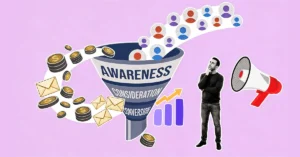
TOFU, MOFU, BOFU are abbreviations that represent three key stages of the marketing funnel: from building awareness to making a purchase decision. Each of these stages requires a different approach to content, messaging, and communication channels.
TOFU (Top of Funnel) is the stage where a user first encounters the topic but is not yet looking for a specific solution.
At this stage, the customer usually does not formulate queries in terms of “buy” or “order.” Their questions are much broader: “what is it?”, “how does it work?”, “why is it important?”. In other words, the user is exploring the context.
That is why TOFU is about explanation, topic exploration, and building trust. At this stage, the brand acts not as a seller, but as a guide who helps users better understand the problem and outline possible directions for solving it.
At the TOFU stage, the main goal is to attract attention. Direct selling does not work here, as the user is not ready for it yet.
The most effective content formats typically include:
MOFU (Middle of Funnel) is the middle stage of the funnel, where the user moves from a general understanding of the problem to searching for specific solutions.
At this stage, the need is already defined. The user compares approaches, tools, or products and evaluates their advantages and disadvantages. Their queries become more specific: “which option is better?”, “how do solutions differ?”, “what should I choose for my task?”.
Thus, MOFU is about argumentation and choice. The key goal here is to help the user navigate alternatives, demonstrate expertise, and guide them toward an informed decision without direct pressure.
At the MOFU stage, content should help users navigate between available options.
The most effective formats here are:
This type of content should demonstrate expertise, respond to more specific queries, and gradually build trust.
BOFU (Bottom of Funnel) is the final stage of the marketing funnel, where the user is very close to making a purchase or is already ready to do so.
At this level, the need is clearly defined. The user has chosen an approach and is now deciding on a vendor, product, or terms of cooperation. They are interested in details: pricing, functionality, case studies, reviews, and demos.
BOFU is about specificity and trust in the solution. This is where it is crucial to remove final doubts, demonstrate practical value, and clearly explain why the user should choose you.
At the BOFU stage, the company’s goal is to help the customer take the final step.
The most effective formats include:
The main goal of BOFU content is conversion.
| Parameter | TOFU | MOFU | BOFU |
| Customer journey stage | Awareness | Consideration | Decision to purchase |
| User intent | Understand the problem or learn about the topic | Find and compare the most relevant solutions | Choose a specific product or vendor |
| Main queries | “what is it”, “how does it work”, “what is it for” | “which option to choose”, “comparison”, “best solutions” | “price”, “reviews”, “demo”, “order” |
| Content type | Blog articles, guides, educational content | Case studies, comparisons, webinars, reviews | Demos, landing pages, commercial offers |
| Search queries | “what is a CRM system” | “CRM for small business: comparison” | “buy CRM price” |
| СТА (call to action) | “Read more”, “Subscribe”, “Download guide” | “See more case studies”, “Register for webinar” | “Request a demo”, “Get consultation”, “Buy” |
To make content in the marketing funnel truly effective, it should be planned as a sequential scenario. This is where the simple logic of content mapping comes in:
topic → funnel stage → format → CTA
Here’s what it looks like in practice:
The effectiveness of content within a marketing funnel cannot be evaluated using a single universal metric. Each stage plays a different role — and therefore requires its own KPIs. What represents success at TOFU will not be relevant for BOFU, and vice versa.
It is important to assess how content contributes to moving the user through the funnel.
1. TOFU — Reach and awareness: At this stage, the key metrics focus on how effectively you attract attention and generate interest. Key metrics:
2. MOFU — Engagement and consideration: At this stage, the focus is on whether the user is willing to engage further with your brand. Key metrics:
3. BOFU — Decision and conversion: The final stage, where the key outcome is a completed action. Key metrics:
This approach allows you to build a transparent system of conversion funnel KPIs and understand where exactly the company may be losing users — at the awareness, consideration, or decision stage.
Even with a solid understanding of the TOFU–MOFU–BOFU model, companies still make typical mistakes that “break” the logic of the funnel and reduce content effectiveness.
To help you avoid learning from your own mistakes, here are the most common ones:
Effective work with TOFU, MOFU, and BOFU is, primarily, about managing data, contacts, and interactions. This is where a CRM system plays a key role, helping transform individual actions into a unified, manageable process.
SMART CRM structures the entire user journey — from the first touchpoint to deal closure and post-sales interactions. This gives companies control over every stage of the funnel and allows them to tailor communication more precisely to real customer needs.
At this stage, SMART CRM:
At this stage, SMART CRM:
At this stage, SMART CRM:
So, breaking down TOFU, MOFU, and BOFU is a way to understand user behavior logic and build relevant interactions with them at every step.
In essence, the entire model comes down to a simple principle: systematic approach → better conversion → predictable results. In other words, every piece of content should have its place, role, and purpose within the overall system.
When content, communication, and tools — including CRM — work in alignment, marketing becomes a structured and manageable process that consistently guides users from initial interest to decision, directly impacting business results.
If you are looking for a system that optimizes your customer interactions, request a consultation, and SMART business experts will help you select and implement a relevant solution.