
Today, CRM for IT companies is as important a component of business process architecture as, say, a load balancer in a complex IT infrastructure. It effectively distributes the load between servers, ensuring uninterrupted operation of the system. The load balancer ensures that no single server is overloaded, and all requests are processed quickly and without errors. A CRM system plays a similar role, distributing tasks and customer requests between teams. For the IT sector, CRM is the main management element, coordinating and optimizing work processes and ensuring proper communication for each customer or partner of the company. This is especially true for sales and marketing teams.
A CRM system allows the team to store and analyze customer data, understand and anticipate their needs, just as a load balancer optimizes request routing based on accurate data. Therefore, thanks to the extensive capabilities of CRM systems, IT companies can automate their business processes and increase their productivity. But each business area has its own specific tasks, and the CRM system must be relevant to their solution. In the IT segment, these tasks are often complex and require flexible and non-standard approaches. SMART business experts, specializing in the development and implementation of modern solutions for customers from the IT sector, know all the intricacies of choosing the right technical solution. Therefore, we share advice from practitioners on which CRM system is best suited for IT companies, taking into account all the nuances and requirements of the industry.
While for other areas of business a CRM system is mainly a means of managing sales or a customer base, for IT companies, a much wider range of complex tasks is assumed:
However, CRM software for an IT company should also take into account a number of more local aspects that also have a direct impact on business processes in this area. Here are some of them:
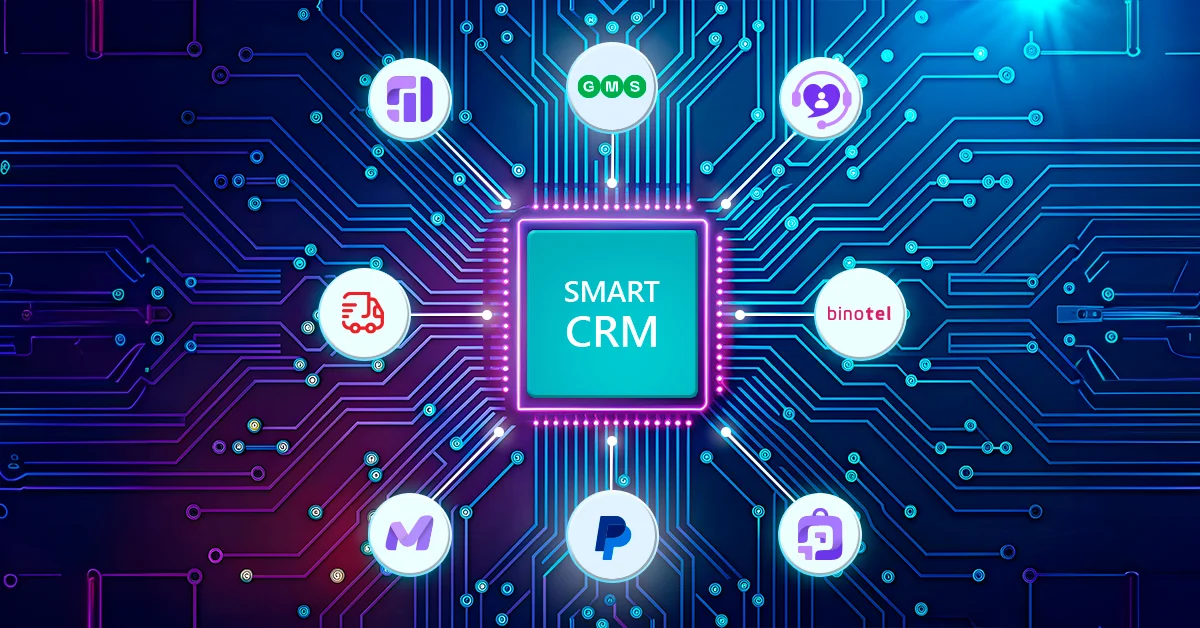
SMART CRM is a prime example of a system that considers the specifics of the IT business. The platform offers a wide range of process automation capabilities, flexible integration with other applications and services, as well as customization to the needs of the company. SMART CRM consists of 4 powerful solutions for B2B sales, B2C orders, registration and processing of requests, and omnichannel marketing management. The functionality of the solutions is expanded by numerous connectors and additional modules that can be installed separately or added as the business scales. Thus, the system can cover the entire list of industry requirements, becoming one of the best CRMs for IT companies.
The IT industry is very diverse and multifaceted, and each company in this sector has its own unique challenges and needs. For some, the key aspect will be project management and coordination of development teams, and for others, sales automation and building effective communication with customers and partners.
Therefore, the choice of a CRM system and its configurations cannot be a one-size-fits-all solution for various IT companies. What is suitable for a startup with a small number of employees may not be powerful enough for a large corporation with a huge range of processes. It is important to consider the specifics of your business and choose a CRM that not only covers today’s needs but is also ready to grow with your company. Let’s take a closer look at the key aspects that you should pay attention to when choosing a CRM for an IT business.
For large companies and corporations, it is important to have a CRM that will allow you to customize the system in accordance with internal specific processes. This can be a customized CRM system, adapted to unique business processes and integrated with other internal company systems: ERP, HCM or LMS solutions, etc.
Next, articulate the goals you want to achieve by implementing CRM. If your main goal is effective project management, choose a CRM with powerful features for tracking tasks, deadlines and team productivity.
If the focus is on interaction with customers and partners, you should choose a system that has integrations with communication solutions. For example, SMART CRM has a solution for managing sales communications, registering and processing written requests or forming a holistic and consistent approach to customers through various communication channels. In addition, to build personalized interaction with the audience, the SMART Chat module combines popular messengers such as Facebook Messenger, Telegram, WhatsApp, Viber, Instagram in one window, and SMART Easy Bot automates communication with users.
To automate sales, your CRM system should provide the ability to manage the customer base, products and their pricing, and have integration with Google Maps for address management. Make sure that the system contains tools for creating a sales funnel, conveniently tracking transaction stages, forecasting income, etc. Integration with SMART Sales offered by SMART business within the SMART CRM platform is ideal for this.
However, if your business has special security policies and requirements or you own server infrastructure, you should consider on-premises solutions that allow you to fully control the processes of storing and processing information on your servers. On-premises CRM systems are installed on the company’s servers, providing full control over data and security. This may be relevant for IT companies working with confidential projects or having limited requirements for data storage.
It is not necessary to immediately integrate all available functionality, connectors and integrations into your CRM system. It is important to expand the functionality step by step, determining at each stage which features are most relevant to the current needs of your business. This approach will help to avoid overpayments, prevent integration from being delayed for a long period or disruption of already established processes. For the implementation to be as effective as possible, you should first find out which functions are currently a priority. In this context, the practical experience of the vendor who will become the implementation partner plays an important role, helping to find the right solution together with the customer.
For example, SOFTICO, one of the leaders in the Ukrainian IT distribution market, initially migrated its business processes from an old CRM system to Dynamics 365 Sales, which better meets the current market realities. Then the company contacted SMART business to implement SMART Connector for Binotel. The integration was aimed at automating and strengthening the customer service of the department working with end customers and the department for working with partners. The integration had to consider that a manager is assigned to each customer or partner. Accordingly, the connector should provide flexible distribution of calls between specialists so that the customer gets to their manager, who is most knowledgeable about their issues. Therefore, much attention was paid to routing capabilities, which were, in fact, ensured by the integration with SMART Connector for Binotel.
As a result, after the implementation, the number of lost calls at SOFTICO decreased by as much as 72.41%, and the average response time decreased by 72.83%. And this is considering the fact that the number of leads has almost tripled. It was the synergy of the customer’s experience and a strong support component on both sides that ensured the rapid integration and high efficiency of this implementation.
As the famous physicist and Nobel Prize winner Sir Denis Gabor said: “The future cannot be predicted, it can be invented”, and SMART business helps its customers shape this future through the implementation of innovative solutions. With SMART CRM, companies can effectively manage customer interactions, adapt faster to market changes and bring their boldest growth strategies to life.