Doubling a customer base sounds like an ambitious goal. But even more challenging is maintaining service quality while growing.
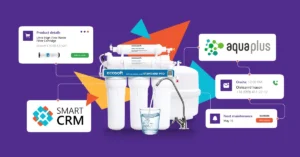
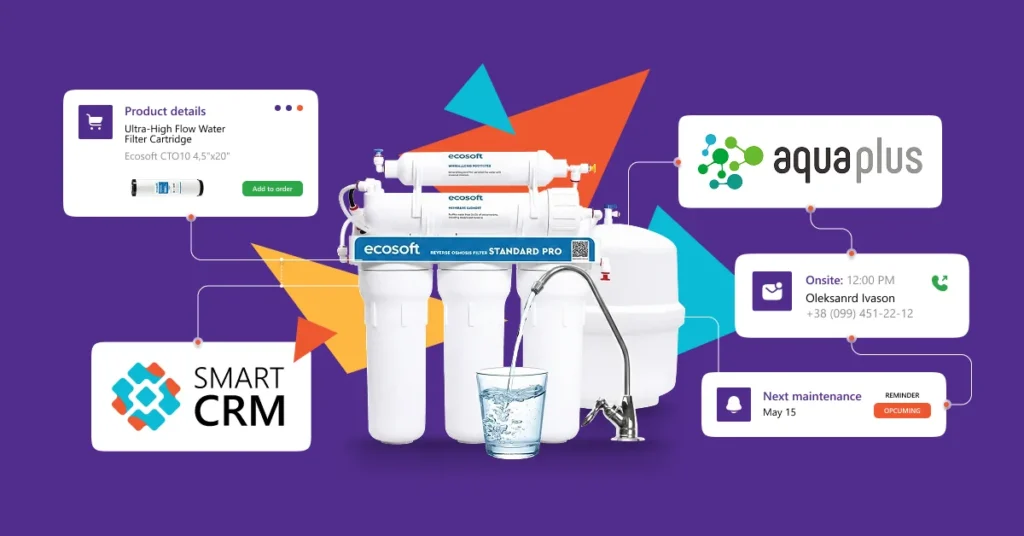
Since 2017, the Aqua Plus team has been systematically promoting a culture of conscious water consumption in Ukraine. The business grew around a simple but powerful idea: clean water should be accessible every day. That’s why the company focuses not only on sales but also on installation, service, and modernization of water purification systems, serving everything from private homes to businesses. Today, Aqua Plus is one of the market leaders in water treatment in western Ukraine and an official partner of Ecosoft Scientific and Production Association, one of the leading water filtration system manufacturers. Aqua Plus intentionally invested in digitalizing its processes to sustain growth without compromising service quality. For this purpose, the company implemented SMART business solutions: SMART Order Management and SMART Connector for GMS within the SMART CRM platform. This phase has already been detailed in a separate case study. Now, after these solutions have stood the test of time and real-world scaling, the team shares practical insights from their own experience.
During a joint webinar with SMART business, Tetiana Luhovska, co-founder and CEO of Aqua Plus, candidly shared how the CRM system helped streamline and automate processes, enhance the team’s personal approach to clients, and achieve twofold growth in just two years without losing control.
As the customer base grew, it became increasingly difficult to keep all processes under control — from current orders to service tasks that require regular reminders. For example, timely cartridge replacements in already installed systems directly affect water quality and customer satisfaction. When dealing with thousands of clients, relying on memory or scattered tools was no longer an option. Collaboration with SMART business began back in 2022, at a time when the company had already reached the limits of its previous CRM. Aqua Plus decided to move away from Bitrix24, which no longer met the real business needs or security requirements. It became clear: the company needed not only a new CRM but also a reliable partner.
A key requirement for migration was to preserve all critical data: customer base, interaction history, service completion records, site photos, and more. These requirements were fully met by the SMART business team. In May 2023, the company completed a full migration from Bitrix24 to SMART CRM, and by September 2023, the Aqua Plus team had fully transitioned to working in the new system.
“SMART business took a deep dive into our business processes so that the system wouldn’t disrupt our established way of working but would enhance it. During software implementations, many companies face a situation where the customer and technical specialists seem to speak ‘different languages.’ With SMART business, we experienced a completely different approach: they listened to us and translated every request to the technical team in a way that ensured everything worked exactly as intended. As a result, the outcome today fully aligns with our business goals.”
The specificity of Aqua Plus’s business lies in its service-driven model with a long customer interaction cycle, where a communication error or a forgotten agreement can cost customer trust. In other words, it’s not enough to simply acquire a customer and close a sale. It is crucial not to lose sight of the client a month, six months, or even a year later — when it’s time for maintenance, cartridge replacement, or a new need arises. The company must remember all agreements, send timely service reminders, and preserve the full interaction context — even when different managers, administrators, and engineers are involved in working with the same customer.
That is why having a single, unified information space is critical for Aqua Plus — one where the entire history of customer interactions is stored. When data is scattered across notebooks, spreadsheets, and personal notes, retrieving the right information at the right time becomes nearly impossible. A centralized CRM database, by contrast, allows teams to work with any parameter — from required equipment types to the next service date — and quickly restore the full context of cooperation.
Another distinct challenge is serving different customer segments. Aqua Plus works with both end consumers (B2C) and businesses and organizations (B2B), including manufacturing companies and educational institutions. Each segment requires a different approach, different data sets, and a different communication logic. SMART CRM enables this personalized approach in a systematic way — not based on intuition, but on structured data.
To support this, the system stores the most complete information possible. For legal entities, this includes company details, incorporation documents, and registered addresses required for contract creation. For private customers, every detail matters: where the client lives, who is typically at home during working hours, and more. For example, the person who orders and pays for the service may not be present during the engineer’s visit, while family members often are. This information is captured in SMART CRM by recording trusted contact persons, significantly simplifying future service delivery.
An equally important component of SMART CRM is equipment data. Knowing exactly which solution is installed for each customer allows the company to clearly understand what should happen next — scheduled maintenance, component replacement, or a potential upsell.
Visual context also plays a critical role. Photos of sites, installation locations, or inspection points are stored directly in the CRM system and used for more than just reporting. In many cases, they make it possible to resolve a customer issue remotely: by reviewing the photos, an engineer can guide the customer over the phone or via voice message without visiting the site. As a result, customers feel supported “here and now,” while the company saves specialists’ time, resources, and costs. This approach creates a shared information environment, where both the team and the customer speak the same language and see the same picture.
“Our cooperation with clients often spans years. Typically, a customer reaches out with an inquiry, receives a consultation, and makes preliminary agreements, but the actual need for equipment installation may arise only after a renovation is completed, a production line is launched, or just before the start of the academic year. If the company reminds the client about itself at the right moment, it is no longer a ‘cold’ sale — it is a continuation of a trusting dialogue. And it is the CRM system that helps us stay in context.”
In practice, the CRM consolidates all the information needed to deliver convenient and predictable service. This is especially critical for businesses with long sales cycles. When a deal can take months or even years, a company must remember not only the client, but also the initial agreements that started the relationship. This is exactly how trust in the brand is built.
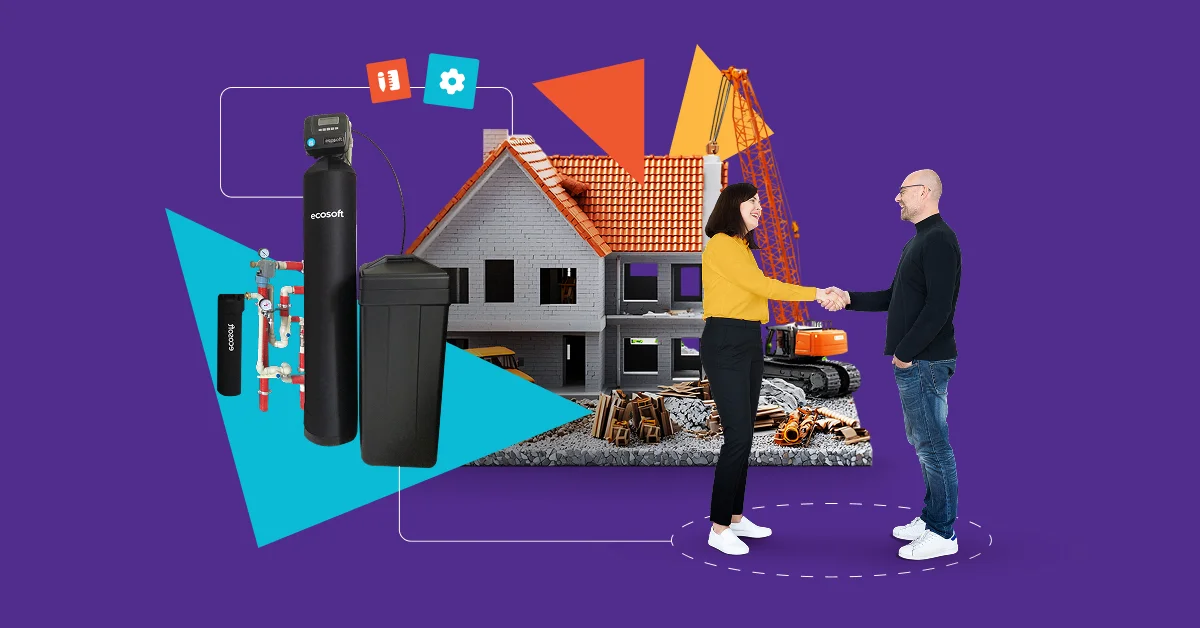
Today, the company actively works with property developers and design studios that recommend installing water purification systems at the early stages of construction or renovation. This approach is logical: systems for both technical and drinking water are far easier to incorporate at the design stage than to retrofit into an already finished interior.
Or, for example, a company may record that in a year or two the customer plans to return to the question of an additional filter or expects special terms. For the customer, it is crucial that this conversation does not have to start from scratch — without having to prove anything again or spend time explaining. If a discount or specific terms were promised, they must be honored. That is why all key agreements are recorded in SMART CRM. Even if the technician, manager, or work schedule changes over time, the core agreements remain unchanged. The customer sees that the company remembers its commitments, which directly contributes to long-term trust.
Thus, thanks to a unified communication flow, Aqua Plus has full visibility into the entire customer journey — from the first contact to service one or two years later. The CRM records all key activities: managers’ work, technicians’ site visits, agreements, engineers’ comments, and customer feedback. The system also stores all related contacts — those who are actually involved in on-site interactions, even if they are not the formal customers.
“When we were just planning to open our company and build the business, we based our idea on honesty, fairness, responsibility, and a high-quality product — so that, as they say, we could look our customers in the eye with confidence. But to uphold this level of responsibility, strong technological support is essential. And today, SMART CRM is exactly that kind of assistant for us.”
Water treatment systems require regular maintenance: filter replacement, equipment condition monitoring, and consultations. The company’s task is not to wait until the customer encounters a problem, but to act proactively so that the customer always has stable water quality without interruptions or emergencies.
This is where SMART CRM plays a key role. After installation or service work is completed, all information about the site is recorded in the system — including when the customer needs to be reminded about the next filter replacement or maintenance. This data becomes the starting point for the next service cycle.
The manager sees the reminder in the system, contacts the customer, agrees on the cost and scope of work, and records the arrangements in the CRM. The process then automatically moves to the next stage: the task is passed to the administrator. The administrator coordinates a convenient date and time for the engineer’s visit with the customer, confirms the on-site contact person, and plans optimal logistics for the team — all within a single, unified information environment.
Once the visit date is confirmed, it is immediately displayed in the engineers’ calendars, and the customer automatically receives an SMS notification with the exact date and time of the specialist’s arrival. This eliminates unnecessary follow-ups, calls, and the risk of misunderstandings.
An important nuance: information in the system is clearly segmented by roles. The manager completes the full customer and site profile, while the administrator receives a concise, structured summary specifically required to organize the visit and support the engineer’s work. This reduces communication noise and speeds up every stage of the process.
After the work is completed, engineers provide photos and results to the administrator. The administrator records the completion, uploads the service completion report to the CRM, and passes the information back to the manager. Having a complete picture of what was done — the condition of the equipment, the engineer’s recommendations, and other details — the manager can close the current order and immediately plan the next steps.
If additional consultation is needed, there is potential for an upsell, or a future visit is required, the manager can see all of this without extra calls or time-consuming searches for information. Various scenarios are then possible: scheduling the next contact or setting reminders months in advance. All decisions are made based on actual data, not assumptions.
“Today, service maintenance accounts for more than 50% of Aqua Plus’ total revenue, and this share continues to grow. After all, the goal of the business is not a one-time transaction, but long-term customer care — providing clean water for years and gradually increasing customer lifetime value.”
A dedicated stage in the company’s workflow is focused on additional sales after the core product has been installed.
For example, at the start of a renovation, a customer may have budgeted only for a technical water filtration system. A drinking water filter might have been postponed due to budget constraints, the kitchen not yet being installed, or simply because there was no immediate need. CRM makes it possible to capture this context and return to the customer at the right moment — in a relevant and non-intrusive way.
In addition, engineers working directly on-site often learn more about customers: someone has purchased a summer house, someone is planning to expand their home, and someone else is preparing to relocate. This real-time feedback is recorded in the system, and based on it, the company forms relevant, personalized offers. As a result, customers feel genuinely considered, while the business achieves sales growth without aggressive pressure.
SMART CRM clearly shows which products the customer is already using, what was installed earlier, and when it makes sense to suggest the next step and execute an upsell. This prevents service from becoming chaotic and sales from being random. Instead, a systematic and predictable interaction model emerges — one in which both sides benefit.
At Aqua Plus, CRM is not perceived as a “magic wand” that transforms the business on its own. A system delivers value only when it is supported by a mature process culture and a team ready to work in a structured way.
“The Aqua Plus case is primarily about the company’s inclination toward process organization and structured work. SMART CRM is just a tool and an assistant. We never aimed to create the illusion that everything was done by the system alone. However, we came to the conclusion that it truly helped and became a contributor to the business’s positive results.”
In the current conditions of the Ukrainian market, automation is no longer a matter of convenience — it has become a matter of business resilience. Qualified specialists are literally worth their weight in gold today, so the more processes a company can remove from manual control, the less dependent it becomes on talent shortages. At the same time, the number of errors decreases as well: forgotten agreements, uncoordinated site visits, scheduling conflicts, and similar issues. At Aqua Plus, the implementation of SMART CRM was viewed as an investment in growth. Once a process is properly configured, it continues to work on its own: sending reminders, providing prompts, and synchronizing people and actions across the organization. One important point, however, is that every business requires the system to be adapted to its own operational logic — and it was precisely this flexibility of SMART CRM that became a decisive factor.
For example, the administrator interface is configured to simplify the planning of engineers’ site visits. A concise order summary allows the administrator to immediately assess the scope and duration of work, while a convenient schedule view makes it easy to see engineers’ workloads and build optimal routes without chaotic travel from one end of the city to the other. Managers, in turn, can group tasks weeks or months in advance, distribute workloads, and view customers by business area and interaction stage.
As a result, every participant in the process — from manager to engineer — plans their time using a single system of reference. For a service company with a large number of site visits, customers, and work types, this is critically important. Without clear organization, even a strong team quickly faces overload.
A separate challenge is seasonal and marketing-driven peaks. For example, campaigns such as Black Friday significantly increase the number of initial sales — and, as a result, the workload for engineers. With SMART CRM, Aqua Plus can flexibly manage these sales waves by consciously shifting some service visits by one or two weeks without compromising the customer experience. For customers, this is usually not critical, as most do not track the lifecycle of their filters — the company takes responsibility for this.
During seasonal slowdowns or vacation periods, CRM makes it possible to evenly redistribute tasks, focus more actively on service and upselling, and keep engineers busy with other types of work. In this way, the system helps balance workloads throughout the year, instead of forcing the company to operate in a constant state of urgency.
“In essence, automation gave Aqua Plus the most important thing — control. Our business gained the ability not only to grow, but also to maintain service quality even as the number of customers, site visits, and processes increases. And this is where we see the key value of CRM: not to replace people, but to help them work more calmly, accurately, and efficiently — for the benefit of both the customer and the business.”
Aqua Plus evaluates the impact of automation not only through hard metrics, but also through the quality of customer interactions. However, numbers best illustrate how a systematic approach translates into growth.
After switching to SMART CRM in 2023, the company recorded a key outcome: the customer base doubled within two years.
This growth was not accidental. It has been the result of several fundamental changes in operations:
In practice, Aqua Plus launched a development spiral:
As a result, every link in the chain benefits: engineers — through stable workloads, managers — through increased sales, and the business — through higher revenue and scalability.
Starting in 2023, CRM became a foundation of trust between Aqua Plus and its customers, delivering:
“In 2022, when we realized that we might be left without a CRM for some time, there was a real fear of chaos. And I’m a person who needs everything to be well organized. That’s why we very quickly started building a new system together with SMART business — step by step, without abrupt moves, but with a clear goal: to achieve what we have today. That is a single information space for sales and service, control over customer commitments, and transparent processes that support business growth rather than slow it down. This is the true ‘magic’ of CRM — the magic of order within your own business. And we were fortunate that SMART business helped us build a tool that made this order possible.”
Today, the system clearly reflects cause-and-effect relationships: once a manager records an agreement, it is implemented by the administrator and executed by the engineer. Everyone sees their role in the shared chain and understands that a mistake at any stage will affect the entire process. This is exactly what fosters accountability and internal discipline.
CRM functionality helps maintain continuous contact with customers through automated reminders, reports on “lost” customers, and mass communications designed to keep relationships active. Because a broken promise does not mean losing just one customer — it also means losing dozens of potential referrals.
Over the past few years, Aqua Plus has grown significantly, and this growth has brought new requirements. While the initial priority was to bring order to sales and service operations, today the focus is shifting toward deeper digital maturity and greater information independence.
The team is deliberately moving toward a model where all key processes operate within a single logic and do not depend on fragmented tools or the human factor. Today’s reality calls for the active use of modern technologies, and Aqua Plus is ready to invest in areas where digitalization genuinely strengthens the business.
Currently, only about 20% of customer interactions take place via phone calls, while approximately 80% happen through messaging apps. That is why the company plans to implement communication modules — SMART Chat and SMART Easy Bot — which will consolidate all communication channels directly within the CRM.
In 2023, the main priority was a fast and secure migration to avoid data loss and business disruption. Now that the system is operating stably, Aqua Plus can confidently expand its functionality to view the full history of customer communications in a single information space, regardless of the channel.
Aqua Plus’s business needs have already gone beyond managing sales and service alone. The company aims to unify finance, analytics, cash flow management, and operational data within a single system — without switching between multiple tools or manually assembling a complete picture.
Statistical data and analytics are especially critical for Aqua Plus. They enable informed management decisions and support long-term planning and sustainable growth.
“I believe it’s difficult to grow without statistics and analytics. As a business owner, you can rely on intuition, but emotions are not always objective. That’s why you need a system that shows the real state of the business in numbers: what works and what doesn’t, where you’re growing and where you’re losing ground. Internally, it’s still not easy for me to fully prepare for ERP implementation, but I clearly understand that there is no alternative if scaling and development are the goals.”
Ultimately, Aqua Plus is moving toward a model where CRM and ERP form a single digital foundation for the business — transparent, manageable, and ready for further growth. The partnership with SMART business enables the company to follow this path not chaotically, but systematically — step by step, with a focus on long-term value for both customers and the business itself.
“If your business is also at a growth stage today — when manual management no longer works and outdated, fragmented tools begin to slow development — this case can serve as a valuable starting point. The SMART business team helps companies build structured, scalable digital models from CRM to ERP, based on real business processes rather than ‘idealized’ frameworks. This is how sustainable growth stories are created: when technology does not complicate work but becomes a reliable foundation for business development and long-term customer trust.”